Unoffendable: How Just One Change Can Make All of Life Better by Brant Hansen
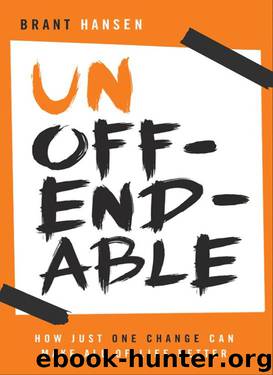
Author:Brant Hansen [Hansen, Brant]
Language: eng
Format: epub, azw3
Tags: ebook
Publisher: Thomas Nelson
Published: 2015-04-13T18:30:00+00:00
14
THIS IS THE CHAPTER ABOUT HOW WE’RE JUST BARELY SMART ENOUGH TO BE STUPID
We humans are weird.
That’s not just my editorial opinion. It’s a biological fact.
We are remarkably unique among all the creatures on the planet. Other creatures feel threatened, just like we do. The big difference, though, is that when they feel threatened, it’s because they’re being chased by, say, a lion. And it makes sense that they’re threatened, since a lion can kill them.
But humans don’t need to be chased by a giant cat or wolves or a shark to feel threatened. We don’t have to be chased by anybody, or anything. We humans are special, because we can manage to feel threatened while being chased by . . .
Absolutely nothing. And amazingly, that “nothing” is killing us.
Maybe you’ve had this scenario happen to you, the “near miss” in traffic. You’re driving a car, and another car comes from out of nowhere, you both slam on the brakes, and you narrowly miss each other. You take a deep breath, say something like “Thank God,” and then make sure everybody’s okay.
But you also notice your whole body feels different. It’s been flooded with hormones, specifically adrenaline and cortisol. Your body went into fight-or-flight mode, perceiving a threat. Your heart rate is now higher, and so is your blood pressure, in order to shoot energy into your body. You’ve got more sugar in your bloodstream now, too, thanks to the cortisol, and that can help your brain think under pressure.
What you may not be aware of is that when you’re in this mode, the “oh-my-goodness-my-life-is-threatened” mode, your body actually automatically shuts down other functions. Your digestive system temporarily closes down, and so does your reproductive system, because you need neither to survive the moment. Your body wants to make you lighter so you can run away, so you may suddenly feel as if you need to go to the bathroom. That’s how we’re wired. It all makes sense. It’s all to help us survive real threats.
All that stuff happens with animals, too, when they’re being chased. If you’re an antelope, and you’re being chased by a pack of bloodthirsty hyenas, you’re having this same thing happen, and maybe you’re thinking, This is awesome; my whole antelope body is making me run faster than I ever thought I could. I love the way I’m equipped with this very cool fight-or-flight response system.
Thing is, for the antelope, the whole thing is over pretty quick. I mean, he either gets away from the hyenas or he doesn’t. In either case, the whole physiological reaction is short-lived. Just a quick blast, really. That’s what fight-or-flight is for.
Robert Sapolsky is a neuroendocrinologist and primatologist at Stanford University, and he studies the way stress affects animals and humans. He’s written a terrific book called Why Zebras Don’t Get Ulcers, which deals with this very issue and explains it much better than I can.1
Zebras have very real threats but don’t get ulcers because that stress-response episode is here and gone in seconds.
Download
Unoffendable: How Just One Change Can Make All of Life Better by Brant Hansen.azw3
This site does not store any files on its server. We only index and link to content provided by other sites. Please contact the content providers to delete copyright contents if any and email us, we'll remove relevant links or contents immediately.
The 5 Love Languages: The Secret to Love That Lasts by Gary Chapman(9790)
The Space Between by Michelle L. Teichman(6929)
Assassin’s Fate by Robin Hobb(6199)
Wiseguy by Nicholas Pileggi(5770)
Everything Happens for a Reason by Kate Bowler(4734)
Gerald's Game by Stephen King(4641)
Pillow Thoughts by Courtney Peppernell(4271)
A Simplified Life by Emily Ley(4158)
The Power of Positive Thinking by Norman Vincent Peale(4062)
Harry Potter and the Prisoner of Azkaban (Book 3) by J. K. Rowling(3350)
Resisting Happiness by Matthew Kelly(3337)
Girl, Wash Your Face by Rachel Hollis(3282)
Being Aware of Being Aware by Rupert Spira(3272)
The Secret Power of Speaking God's Word by Joyce Meyer(3180)
The Code Book by Simon Singh(3178)
More Language of Letting Go: 366 New Daily Meditations by Melody Beattie(3023)
Real Sex by Lauren F. Winner(3014)
Name Book, The: Over 10,000 Names--Their Meanings, Origins, and Spiritual Significance by Astoria Dorothy(2979)
The Holy Spirit by Billy Graham(2944)
